
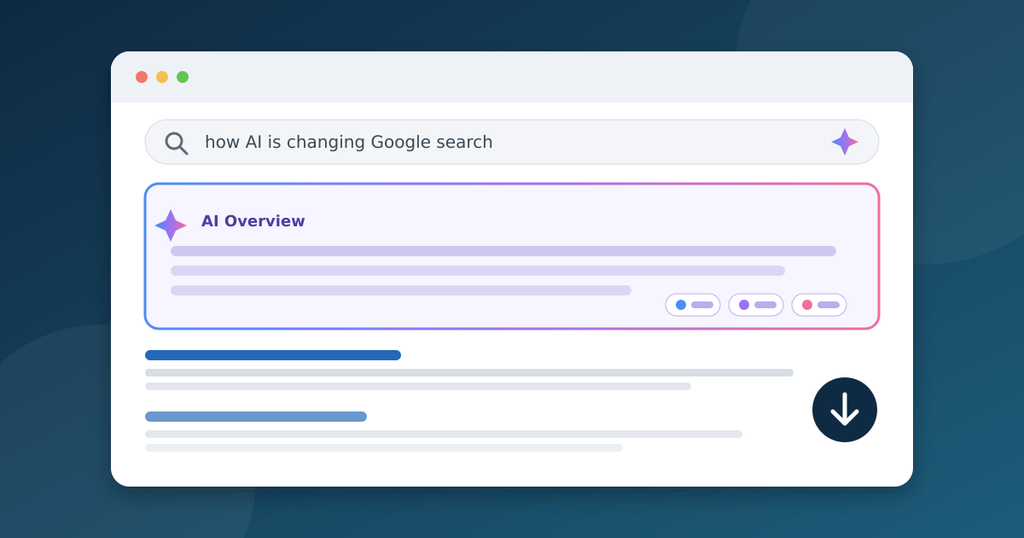
If you work in SEO or run a website, you’ve probably noticed that Google’s results page looks different. Understanding how AI is changing Google search is now part of running any business that relies on traffic.
Answers appear at the top of the page. Citations sit inside AI-written summaries… Ranking first no longer guarantees a click.
I work in marketing, focusing on SEO and content strategy. I’ve spent a lot of time watching these changes and checking AI Overviews myself. This guide explains what’s changing, what I’ve noticed, and the one thing I’d do this month.
How AI Is Changing Google Search in 2026
Google has moved quickly. At I/O on May 20, Google merged AI Overviews and AI Mode into one experience built on Gemini 3.5 Flash. It also rebuilt the search box for the first time in over 25 years, so it now accepts images, files, and video alongside text.
The scale is large. Google says AI Overviews has more than 2.5 billion monthly active users, and AI Mode has more than 1 billion.
The way Google Search is changing with AI
Here is what that means in practice:
Answers come first. Searchers get a summary before they see any links.
Searches get longer. People ask partial questions and follow up in the same session.
Citations are a kind of visibility. Google says it is adding publisher links inside AI Overviews and AI Mode placed next to the relevant text.
Why Rankings Alone Don’t Tell the Whole Story
Many marketers see the pattern. Rankings look stable. Clicks fall. When that happens, AI Overviews answering the question before anyone clicks is the likely cause, and it isn’t a penalty.
Question-style searches are the exposed. Queries like “How do I…” and “What’s the difference between…” are what AI Mode handles best, so they’re the least likely to drive a click.
The link between ranking and citation also looks weaker than it used to. One industry analysis found that top-10 pages made up 76% of AI Overview citations in mid-2025 but about 38% by early 2026. Treat that as a signal since methods differ between studies.
The takeaway is simple. Ranking is still important. It’s no longer the whole game.
What I Notice When I Check AI Overviews
I want to be clear about this section. These are my observations from checking results, not a controlled study.
Pages that seem to get cited
- Pages with a clear, direct answer to the question
- Content with strong topical relevance and a logical structure
- Specific explanations, original information, and real examples
Pages that seem to get skipped
- Vague pages that circle the topic without answering it
- Overly promotional pages
- Poorly structured pages with little original value
The query type matters too. Informational searches tend to trigger AI answers. Specific or transactional searches behave differently depending on the query and the available sources.
My main takeaway is that SEO fundamentals still matter… A page now has to prove relevance, depth, and credibility to compete.
Old SEO Focus vs. AI-Era SEO Focus
| Area | Traditional Focus | What Also Matters Now |
|---|---|---|
| Goal | Rank in the top 10 | Get ranked, cited, and mentioned in AI-generated results |
| Content | Keyword coverage | Clear answers, unique insights, and first-hand experience |
| Measurement | Clicks and rankings | Impressions in AI features, brand visibility, and qualified traffic |
| Page Structure | Headings and keywords | Direct answers, FAQs, and scannable sections |
| Authority | Backlinks | Topical depth and demonstrated expertise |
The Biggest Mistakes I See Businesses Making
Treating AI as a replacement for strategy
Some businesses are publishing huge amounts of AI-generated content. They don’t ask whether it’s accurate, original, or useful. AI can speed up research and drafting. It can’t replace audience knowledge, expertise, or human insight.
Watching ranking positions
Visibility now also happens through citations, brand mentions, and featured information. A business that tracks blue-link positions is missing part of the picture.
Hunting for an “AI Overviews trick”
There’s no playbook. Google’s own AI optimization guidance says AI Overviews and AI Mode pull from the index using the same quality signals as regular results. Chasing shortcuts wastes time you could spend improving your pages.
how AI is changing Google Search
The One Thing to Do This Month
If you only have time for one task, audit and improve your important pages around real customer questions. Here’s how:
Collect the questions. Look at what customers ask before they buy. Use Google Search Console, keyword research tools, sales conversations, and Google’s related searches.
Pick your pages. Choose several high-value pages, such as core service or product pages.
Check the answers. Ask whether each page answers those questions clearly, accurately, and completely.
Add what AI can’t copy. Include first-hand experience insights, examples, and supporting data.
Tidy the structure. Use headings, a short FAQ, internal links, and accurate business information.
Measure. Search Console now includes AI stats showing impressions, which pages appear in AI responses, and in which countries. Use them to see where you show up.
AI-driven Google Search
The goal isn’t to manipulate AI Overviews. It’s to build a site that shows expertise and helps people. Improving a handful of pages thoroughly beats publishing dozens of articles with no plan.
Limitations to Keep in Mind
Results vary. AI Mode can personalize results. No brand can guarantee its page appears for every user.
AI is changing Google Search
The landscape moves fast. Features, names, and numbers change often, so check Google’s documentation before making decisions.
Not every business is affected equally. Local, transactional, and highly specific queries may be impacted more than broad informational ones.
FAQs
Is SEO because of AI?
No. AI features draw on the index and quality signals as regular search. What changes is how visibility is earned and measured.
How do I get my content cited in AI Overviews?
Answer the question clearly, back it with insight and credible sources, and structure the page well. There’s no guaranteed method.
Can I opt out of AI Overviews?
Yes, partly. Google added a Search Console toggle that lets sites opt out of AI Overviews and AI Mode and says it won’t affect Search rankings. Opting out also means giving up that visibility, so weigh it carefully.
how AI is changing Google Search
Should I stop using AI to write content?
No. Use it as a tool for research and drafts. Keep expertise, fact-checking, and original insight in the final piece.
Understanding how AI is changing Google search comes down to an idea. Answers appear before clicks. Visibility now includes citations and brand mentions… The fundamentals of useful, credible content matter more than ever.
how AI is changing Google Search
For more background on how search technology has evolved, you can explore the Wikipedia page on search engines
Explore my digital marketing services to learn more about SEO, social media marketing, and strategies for building a stronger online presence.